We develop hard-to-make medicines, from molecule to finished dosage form.

Scroll down

Polpharma Group synthesises the active substance and develops the finished dosage forms around it, specialising in complex sterile, inhaled and combination products, up to an oligonucleotide pipeline in development for registration.

Developed products

260+

products in development

100+

specialized r&d centers

6

Full time employees

300+

doctorates

37

invested in R&D since 2000

€0.5B+

FDF R&D Centers

R&D network specialised by dosage form.
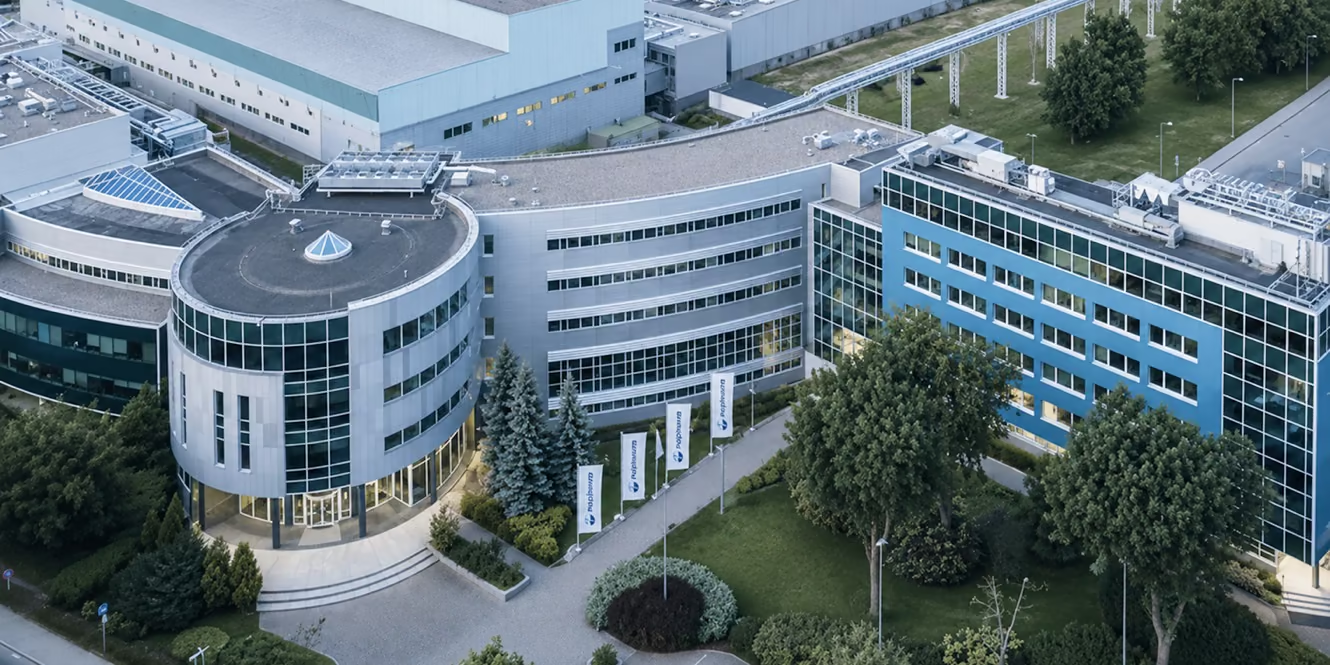
Starogard Gdański
,
Poland
ZF Polpharma

Solid oral dosage forms

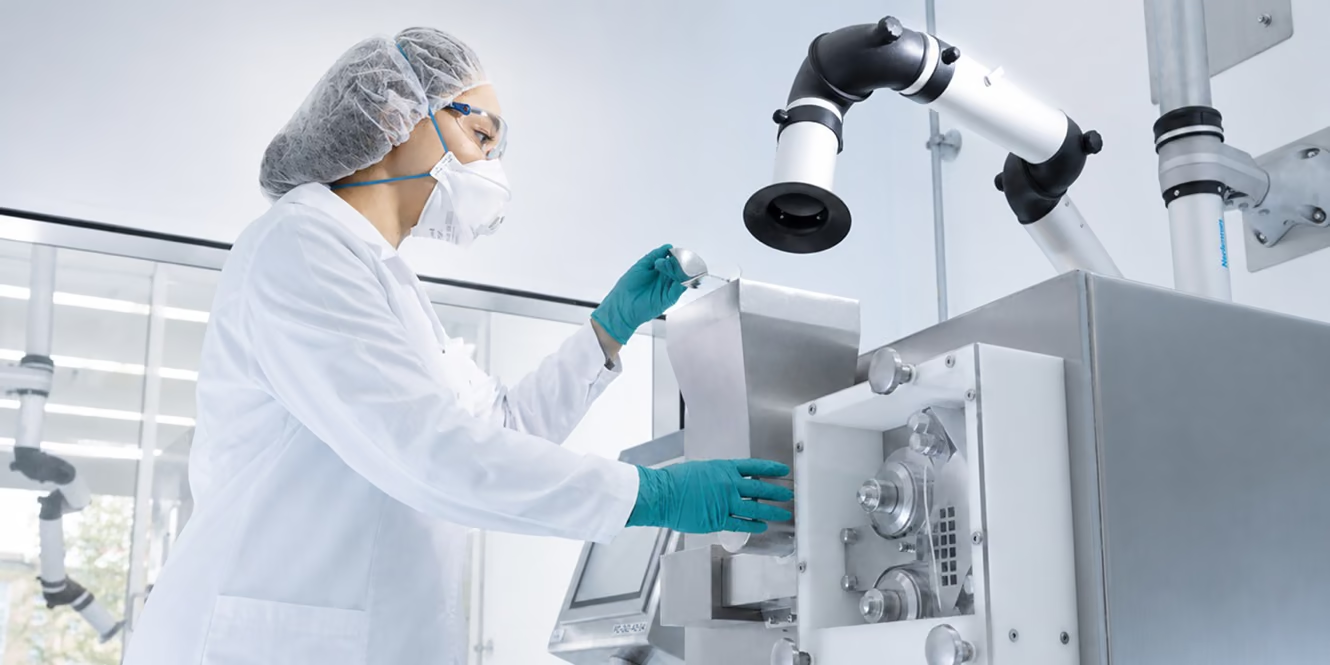
The Group's largest R&D centre, with advanced preformulation capabilities and deep expertise in drug-product technology and analytics. End-to-end development across the full range of solid oral dosage forms, from feasibility through to GMP-certified pilot-scale batches for clinical trials.
Warsaw
,
Poland
ZF Polpharma

Sterile & complex injectable

Sterile liquid forms across the range - solutions, emulsions, lyophilisates and infusions - alongside soft gelatin capsules, including gastro-resistant forms. The centre also develops long-acting injectables nano-formulated for monthly dosing, oligonucleotide and peptide drug products, and preservative-free ophthalmics for multi-dose use.
Sieradz
,
Poland
ZF Polpharma

Inhalation & non-sterile forms

Dry-powder inhalers developed as one product – device and powder engineered together so the delivered dose holds across a patient's technique. Semisolid gels and non-sterile liquids are also developed here. An inhalation-powder pilot line runs on site, with a dedicated DPI plant under construction nearby; the centre sits beside the Medana plant that manufactures what it develops.
Shymkent
,
Kazakhstan
Polpharma Santo

Generic medicines development

The regional R&D center dedicated to the development and adaptation of generic medicines for regional markets, with a primary focus on solid oral dosage forms and antibiotics. The site provides formulation and process development, supports technology transfer, and contributes to regulatory submissions and lifecycle management, ensuring products meet local requirements and market expectations.

API R&D Centers

Active-ingredient development specialized by potency.
Starogard Gdański
,
Poland
ZF Polpharma

Small molecules & oligonucleotides

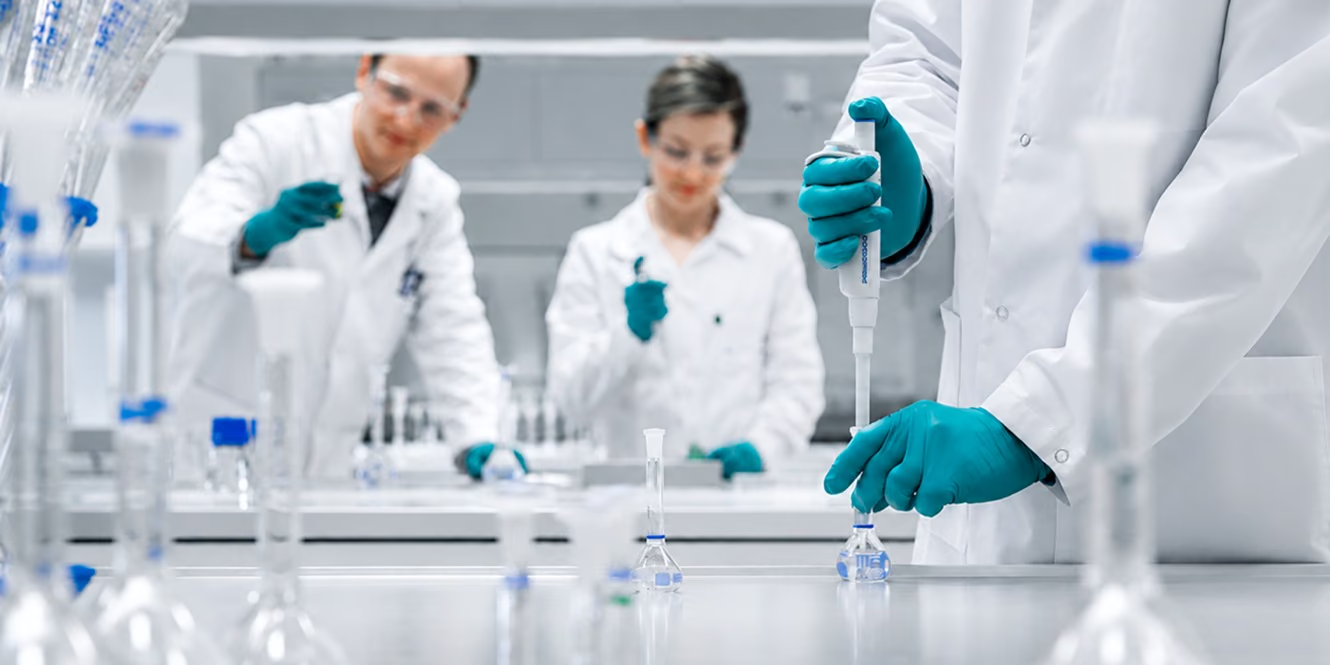
Active-substance R&D for the Group's own pipeline and for development partners: route design, analytical method development and solid-state chemistry, from feasibility studies through to kilo-scale GMP batches. Alongside standard small-molecule work, the centre develops oligonucleotides through to chromatographic purification and runs cryogenic synthesis, reaching into chemistry most generic makers outsource.
Starogard Gdański
,
Poland
ZF Polpharma

Highly-potent compounds & ADC

A dedicated R&D and kilo-lab facility, opened in 2024, for the Group's most potent chemistry: high-potency active ingredients up to OEB 6, and ADC payload-linker development. Process and analytical development run under isolator containment, with kilo-scale GMP batches from 50 grams to 1.5 kilograms for clinical and registration supply.

The development standard

A product leaves R&D only when it is stable, bioequivalent, reproducible, and patent-clear.

Preformulation, analytical & stability development

Preformulation, method development and validation, and a stability programme that proves shelf-life chemically and physically, with no polymorphic shift. Impurity work builds nitrosamine control into the method from the start.

Synthesis, formulation & process development

Formulation, then scale-up to a process validated at commercial scale. IP and regulatory strategy are set at route assessment, so the form is built around a clear patent position from the first feasibility study.

Bioequivalence
& clinical studies

We support product registration through robust study design, coordination and execution. Working with experienced partners worldwide, we ensure compliance with international regulatory standards throughout the process.

what it takes

We carry a molecule all the way to marketing authorisation.

The process is run for the Group's own pipeline and for development partners, from the first feasibility study to granted authorisation.

1
EVALUATION

Feasibility

Route and formulation feasibility assessed with the patent position and regulatory path, committed only when the market is open.

EVALUATION
2
DEVELOPMENT

Development

Formulation and synthetic process developed and scaled from lab to pilot, built for transfer to commercial manufacturing without redesign.

DEVELOPMENT
3
VALIDATION & REGISTRATION

Validation batches

Bioequivalence and registration batches made to dossier specification, with the stability programme running alongside.

VALIDATION & REGISTRATION
4
SUBMISSION

Dossier

A complete CTD dossier assembled and submitted, prepared for the EU procedures and the registration markets the product is intended for.

SUBMISSION
5
MARKETING AUTHORISATION

Approval

Authority review through to granted marketing authorisation, clearing the product for supply in each market filed.

MARKETING AUTHORISATION
Previous
Next

innovation & pipeline

Innovation, from a generic tablet to a synthetic-RNA oligonucleotide.

From platform to oligonucleotide pipeline

An oligonucleotide programme built on solid-phase synthesis with sterile downstream and lyophilisation - the Group's first synthetic-RNA products, in development for registration and backed by its own manufacturing platform.
Oligonucleotides

Preservative-free eye drops

Multidose eye drops formulated without benzalkonium chloride - the preservative classed as irritant and local cytotoxic, and held sterile across a full course. Nine products. First in Europe.
Ophthalmology

Dry-powder inhalers

Inhaler and powder developed as one, so the delivered dose holds across a patient's inhalation technique.
Respiratory

Single-pill combinations

Up to three antihypertensive and heart-failure actives combined in one tablet, each kept chemically stable and bioequivalent to the originals it replaces.
Cardiology
Next
Next

Group’s commentary

Our innovation comes from a new route of administration, formulation, or combination of actives, a device co-developed with the medicine, or a synthesis route engineered around the patent - protected by 52 patents granted in the last five years, with 32 applications pending.

sole-source

We are the only developer of generic orlistat in the EU, alongside disulfiram implantation tablets.

Behind the pipeline

300+ scientists, 37 of them doctorates, and a research base that extends well beyond our own labs.

Polpharma has put more than €0.5 billion into R&D since 2000 - work co-funded by competitive grants, run alongside national research institutes, and fed by a talent pipeline the company trains itself.

External funding

Ten development programmes carry external grant funding that refunds 40 to 60 percent of specific phase costs - over €40 million secured across the programme, with a further €6.5 million pending decision.

Scientific partnerships

Active research partnerships with the Łukasiewicz Network, the National Medicines Institute, Medical University of Gdańsk, Medical University of Lódź, and the Institute of Bioorganic Chemistry of the Polish Academy of Sciences anchor the work in the national research base.

Talent pipeline

Industrial PhD candidates run their doctoral research on live development programmes, co-supervised by the company and their university - the talent pipeline that fills the product pipeline.

External innovation & industry partnerships

We don’t build everything ourselves. We work with external partners where it makes sense – to access technologies, speed up development and stay focused on what we do best.

PARTNERSHIP models

Develop with the platform we built for our own pipeline.

Own Pipeline

More than 100 products in development across the Group, from oral solids to oligonucleotides - the portfolio Polpharma develops and launches under its own brands.
Our molecules. Our brands.

API Co-development

Joint ownership of a new substance neither side has carried alone: the Group brings chemistry, regulatory infrastructure and commercial-scale manufacturing, you bring target, clinical strategy and market access. Cost, IP and split agreed up front.
Shared cost. Shared upside.

FDF Co-development

A finished product designed around your active substance - formulation, process and dossier through bioequivalence - then carried to validated commercial supply on the Group's own FDF network, with shared risk available across the project.
Your molecule. Our dose form.

API CDMO

A molecule with no route yet, developed from feasibility through to commercial supply, with the high-potent, oligonucleotide and cryogenic platforms available from the first step. Route assessment to CEP, EU and US DMF filing on one site, and contract manufacturing of an established substance runs as the commercial stage of the same model.
Your molecule. Our chemistry.

Strategic R&D Partnership

Longer-term alliances beyond a single transaction: joint research with universities and institutes alongside M&A, joint ventures, long-term supply and back-integration, co-owned where agreed and carried through to a registered product.
Multi-stage. Multi-year.

"In the development of a second-generation drug, we seek innovative technologies. Our main objectives are improving product stability, having a positive impact on the environment, and improving patient comfort. This requires extensive research work and takes from three to ten years, involving top-class specialists from many scientific disciplines.

Katarzyna Malik Head of r&d

WHY US

From the chemistry of the active substance to the finished pharmaceutical product, on one integrated platform.

Development, scale-up and manufacturing of the active substance and finished form run in one group that also registers and sells the medicine. R&D is built against commercial-scale manufacturability and each market's regulatory requirements.

Patent-clear by design

The chemistry is engineered clear of third-party patents, and the dossier is prepared and filed during the patent term, so marketing authorisation is in place the day it expires.

Proven in the clinic

The complex injectables, including long-acting injectables, are carried through human studies that go past simple bioequivalence, which their generic approval demands.

Owned past launch

R&D keeps working on products after launch - improving processes on marketed lines, and re-engineering products to meet nitrosamine limits when the guidance changed.